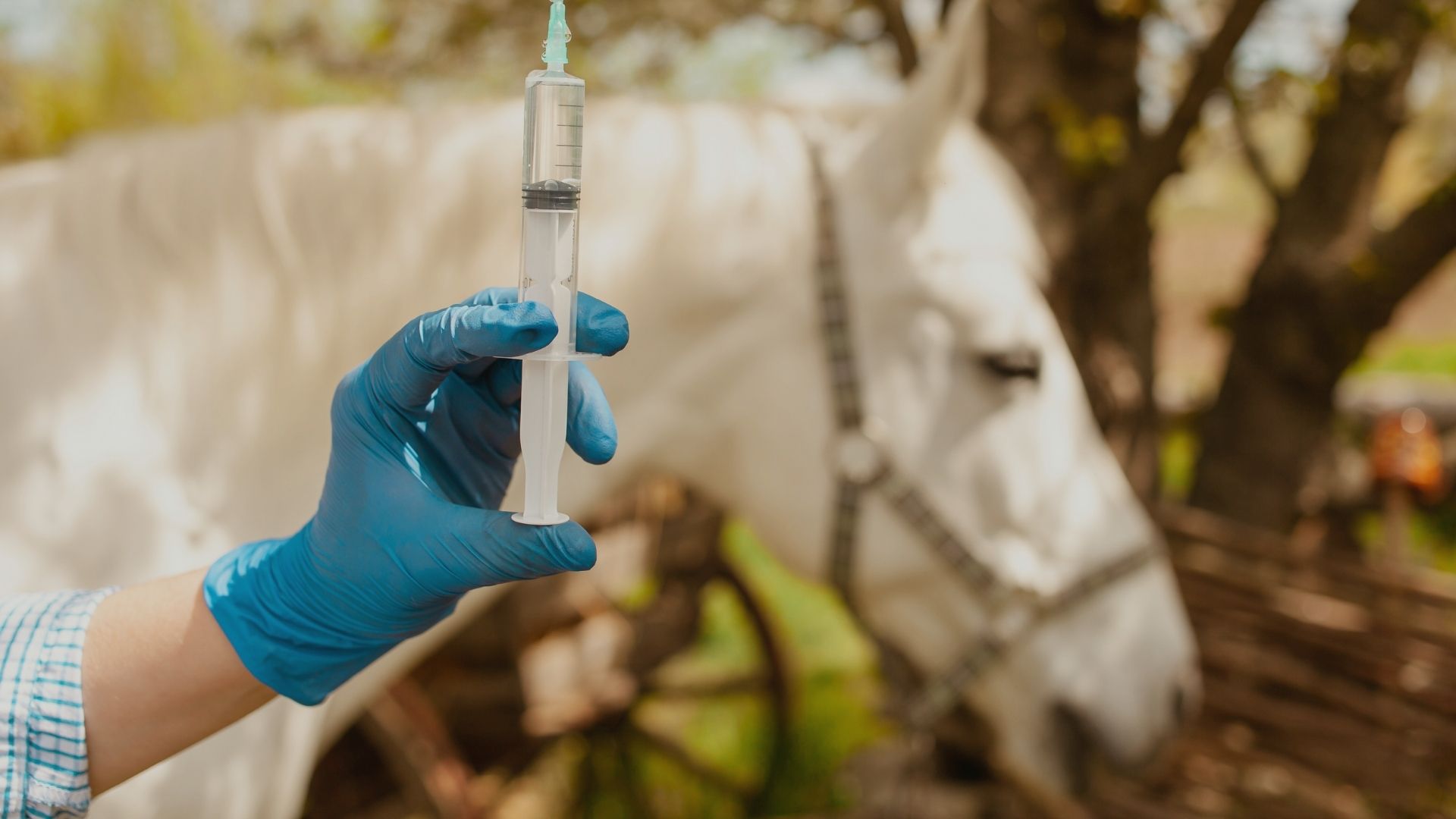
When your horse is afraid of needles, even routine healthcare can become stressful
A vaccination shouldn't feel like a major event. And yet, when you have a needle-shy horse, you may already be worrying about it days before the vet arrives:
- Will my horse stand still this time?
- Will we be able to get it done?
- Should I hold them more firmly? Distract them with food? Practise beforehand?
- And what if their fear is getting worse?
Perhaps your horse only moves away when the needle appears.
Or perhaps you've reached the point where they become tense as soon as someone approaches their neck, or see the vet approaching them - and they tend to pull away, rear, strike, or desperately try to escape.
Whatever needle-shyness looks like for your horse, simply getting the injection done doesn't necessarily solve the problem.
Because the behaviour you see is only one part of the story.
To create lasting change, we need to understand what your horse is actually afraid of — and start there.
This isn't about teaching your horse to “put up with it.”
It's about helping them feel differently about it.
There is an important difference between a horse who stands still because they have no other option, and a horse who stays because they genuinely feel safe enough to participate.
Force, restraint, or simply repeating injections may sometimes get a necessary procedure done.
But standing still doesn't automatically mean feeling safe. And repeated exposure alone doesn't necessarily make fear disappear.
That's why we'll approach needle-shyness differently. We'll look beneath the unwanted behaviour and begin asking:
- What is my horse communicating?
- Where does their fear begin?
- What can they already cope with comfortably?
- And how can I build from there?
Because the goal isn't simply a horse who allows an injection somehow. It's a horse who can feel increasingly safe, confident, and involved in their own care.
Inside your free guide, you'll learn how to:
- Recognise where your horse's needle fear really begins — because the needle itself may only be one part of the problem
- Spot the subtle signs of discomfort before they become a big reaction, so you can respond earlier
- Understand why “just getting it done” can make needle-shyness worse, even when the horse eventually stands still
- Find your horse's individual starting point instead of following a one-size-fits-all training protocol
- Use desensitisation and positive associations thoughtfully to begin changing how your horse feels
- Introduce choice and consent into healthcare training so your horse can become an active participant rather than a passive recipient
- And most importantly, take a few small, practical steps with your own horse straight away
You don't need special equipment. You don't need to practise with a real needle - in fact, as a vet, I don´t even recommend that owners use sharp objects that can hurt the horse´s skin.
And also, you don't need to fix the entire problem in one training session.
You just need to find the right place to start.
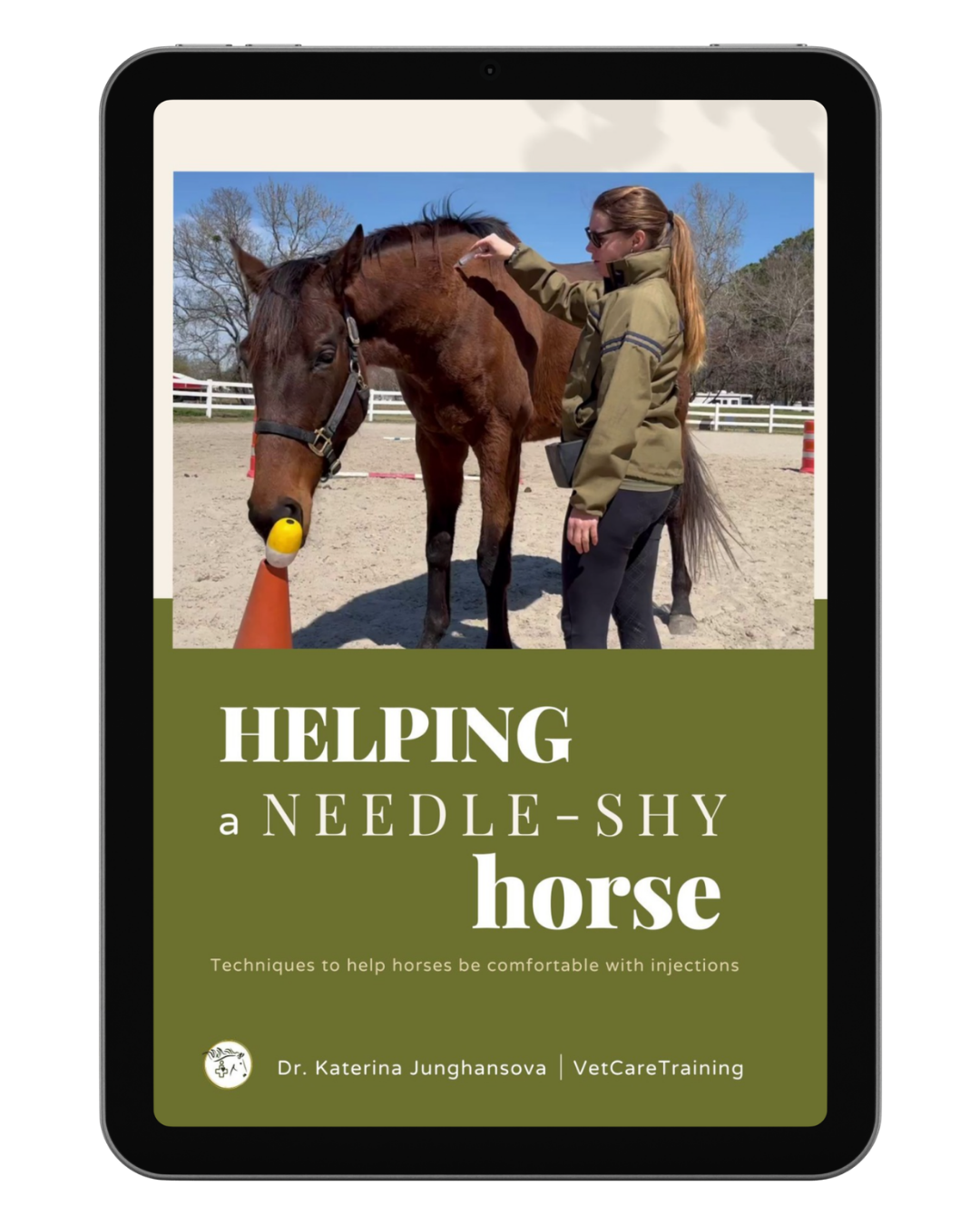
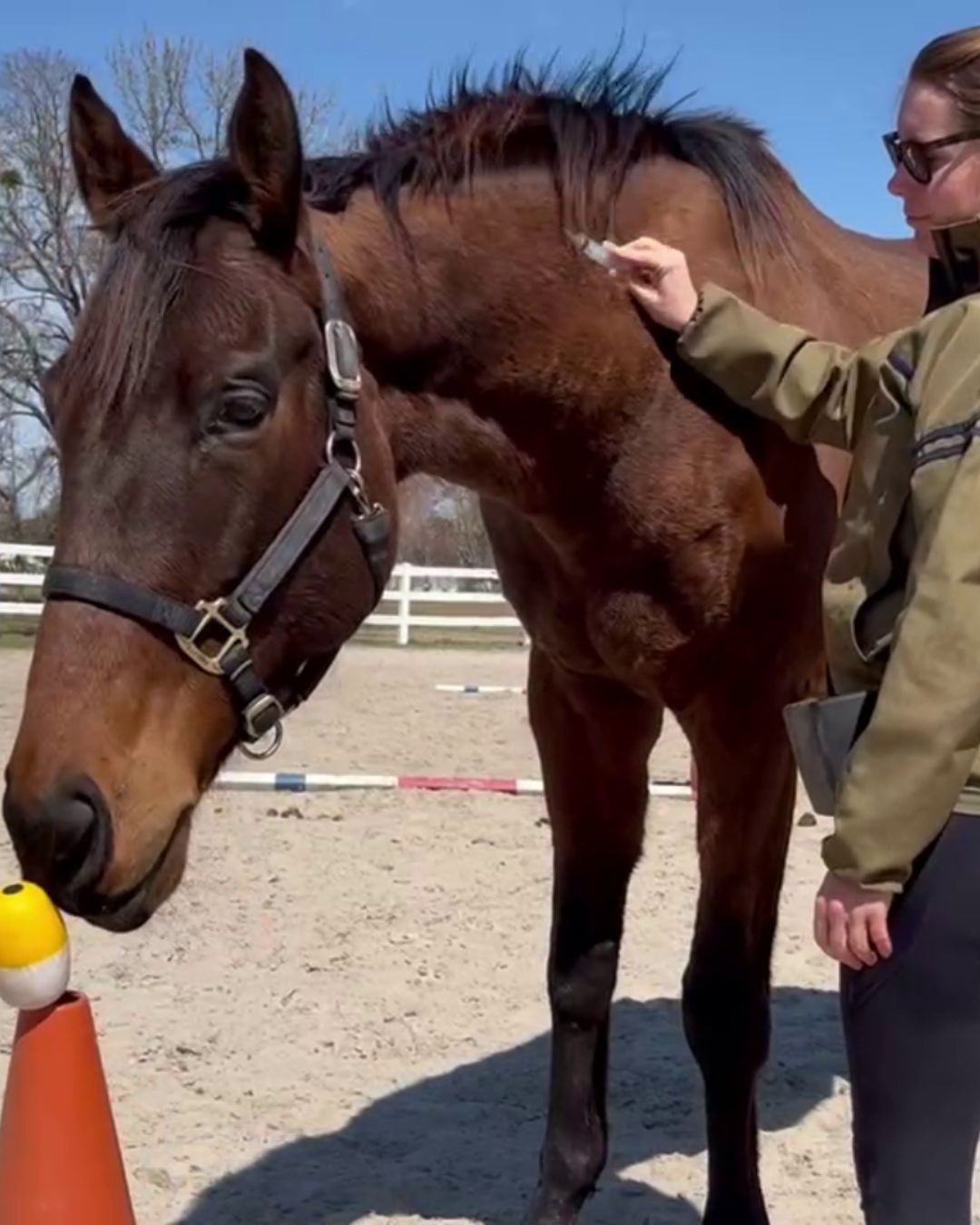
Imagine noticing something you hadn't seen before.
You go to your horse after reading the guide.
This time, instead of immediately practising “injections,” you simply observe.
You touch their neck. They're comfortable. You apply slightly more pressure. Still comfortable. You gently pinch the skin...
and there it is.
A small head movement. A little tension. A step away.
Something that might previously have seemed insignificant suddenly gives you useful information.
“Ah. This is where we need to start.”
That's the kind of progress I want this guide to help you make.
Not a miracle transformation overnight.
Clarity. A better understanding of your horse. One successful first step.
Because once you understand where the problem begins, you can make much better decisions about what to do next.
What if your horse could eventually say: “I'm ready”?
This is where cooperative care can completely change the conversation.
Instead of healthcare being something we simply do to the horse, we can teach horses ways to actively participate.
For example, a horse can learn a simple START button behaviour that communicates:
“I'm ready. You can continue.”
And when they withdraw that signal?
You listen.
Over time, choice and predictability can help change the horse's experience from:
“I need to escape from this.”
to:
“I understand what's happening. I have a voice. I can participate.”
Inside the guide, I'll introduce you to this approach and show you what a START button can look like in practice.
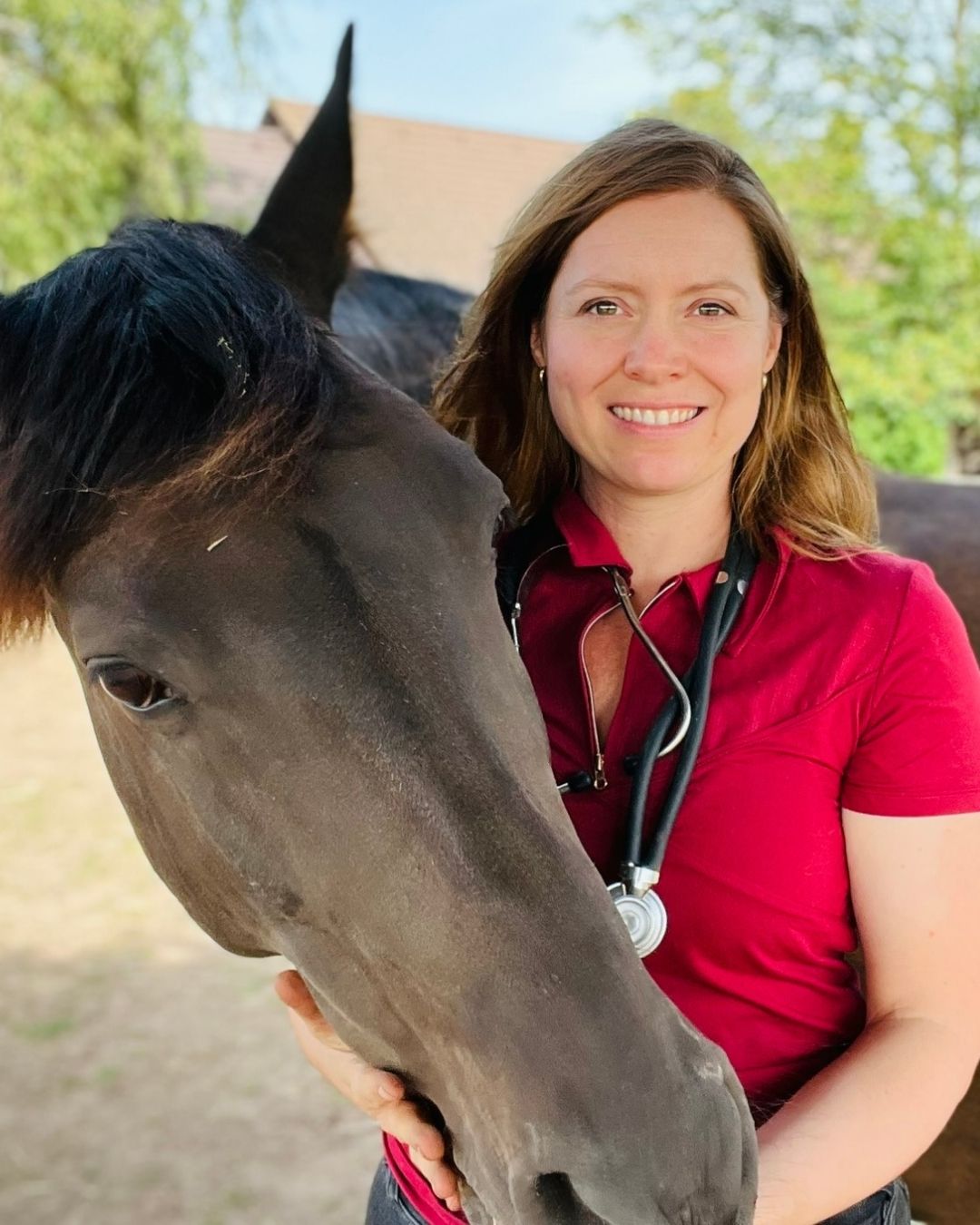
Hi, I'm Katerina
I'm an equine veterinarian, cooperative care trainer, and founder of The Cooperative Equine.
My work brings together veterinary knowledge, learning science, low-stress handling, and cooperative care to help equines and their humans navigate healthcare differently.
Because after working with horses around veterinary procedures, I've become much less interested in asking:
“How can we make this horse comply?”
I'm much more interested in asking:
“What does this horse need to be willing to cooperate?”
There is rarely one technique that works for every needle-shy horse.
Their previous experiences are different. Their triggers are different. Their behaviour is different.
So their path towards feeling safe needs to reflect that.
This guide will help you start looking at needle-shyness through that lens.
Not as a battle you need to win. But as a problem you can understand, break down, and begin working through together.
Your horse's next injection doesn't have to look like the last one
You don't need to solve your horse's needle phobia today.
Start smaller:
- Learn what your horse is communicating
- Find the point where they still feel comfortable
- And take one step from there
I'll show you how ↓
Download Helping a Needle-Shy Horse for free.
Practical. Evidence-informed. Force-free.
Help your horse feel safer around injections — one small step at a time.